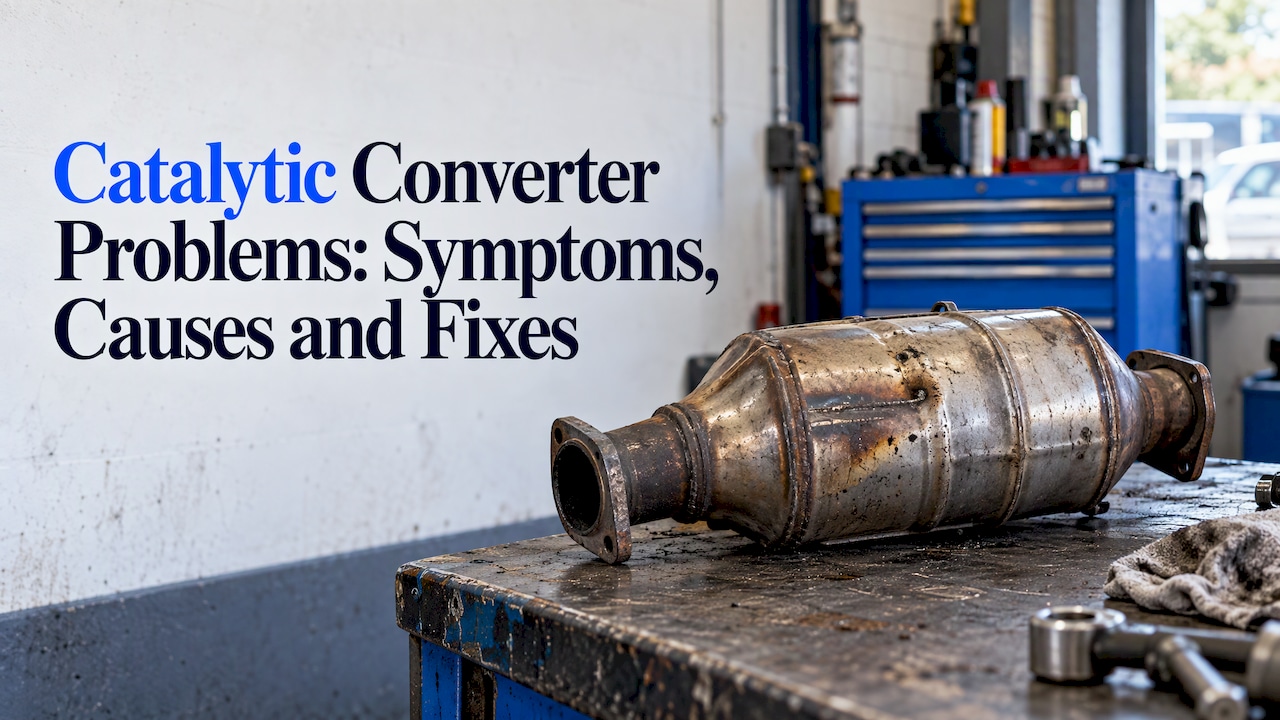
A failing catalytic converter usually shows up as lost power, a rotten-egg smell, a rattle under the car or a warning light. The converter is often the victim rather than the culprit, so the fix that works is to find what damaged it, put that right, and then fit a replacement that is correct for your exact car. That last step is where registration or VIN matching earns its keep, because the wrong converter is an expensive mistake. At A-Z Motor Factors you can check a part against your vehicle’s registration or VIN before you buy.
TL;DR
- Typical signs of converter trouble: sluggish performance, dark exhaust smoke, a sulphur smell, rattling from underneath and a dashboard warning light.
- A warning light alone does not prove the converter is faulty. Fault codes and sensor readings come first.
- Misfires, rich running, oil or coolant getting into the exhaust and physical knocks are the usual ways a converter is killed. Fix those or the new one can fail too.
- In the UK, a replacement for a car registered on or after 1 March 2001 must be type-approved, and the markings must be on the unit.
- Check the part against your registration or VIN before ordering, and keep the return window in mind.
Table of Contents
- What a catalytic converter does, and which type your car has
- Bad catalytic converter symptoms
- Why converters fail
- How to diagnose it properly
- What the MOT looks at
- How to fix catalytic converter problems
- Choosing the right replacement converter
- Order the right part first time
- Our view on converter problems
- FAQ
- Sources
What a catalytic converter does, and which type your car has
The converter sits in the exhaust and turns the worst of the engine’s emissions into less harmful gases. Every petrol car sold in the UK since 1993 must legally have one, so if your car is petrol and newer than that, it has one.
There are two main types you will meet when searching for parts:
- Two-way converters use platinum and palladium to break down carbon monoxide and hydrocarbons. Carwow notes they are no longer found in modern cars.
- Three-way converters add rhodium so they also deal with oxides of nitrogen. They are commonplace on petrol cars, and the AECC, the European emissions-control industry body, describes them as the main technology for petrol engines, working with an oxygen sensor in a closed loop.
Diesels are different. Diesel exhaust carries too much oxygen for a three-way catalyst, so diesel cars use an oxidation catalyst plus other aftertreatment. In practice that means a diesel particulate filter, which has its own warning light: our DPF warning light guide covers it. Electric cars have no catalytic converter at all.
Which converter your car needs depends on its model year, engine size and the emissions standard it was built to. That is why guessing from a photo or a part number copied from another listing goes wrong so often.
Bad catalytic converter symptoms
No single sign is conclusive, but several together point strongly at the exhaust. RAC Drive lists these possible symptoms:
- sluggish performance and reduced acceleration
- dark exhaust smoke
- a sulphur or rotten-egg smell
- excessive heat beneath the vehicle
AXA’s guide to converters adds changed fuel consumption and rattling under the car. A rattle often means the ceramic core inside has broken up. If you want a second checklist to compare against, this rundown of catalytic converter failure symptoms covers the same ground in more detail.
The warning light
Modern cars use oxygen sensors and on-board diagnostics to spot changes in the exhaust, so a dashboard light may come on when the converter is not working properly, according to RAC Drive. The light is a prompt to read the fault codes, not a verdict. A misfire, a failed sensor or an exhaust leak can all trigger it. If the engine management light is also an MOT concern for you, our guide to the engine warning light MOT failure explains what testers look for.
If the engine is also stalling or running rough, read our stalling checklist alongside this one, because those faults feed straight into converter damage.
Why converters fail
The useful thing to know is that a converter rarely wears out. In normal use it should last the life of the car, so when one fails, something upstream or underneath nearly always did it. The causes fall into three groups.
Damage from the engine side
Unburned fuel reaching a hot converter can overheat it. The usual sources are misfires and an over-rich mixture. Professional Motor Mechanic, a UK technical publication, warns that an ignition fault can damage a converter while being mistaken for converter inefficiency. RAC Drive also names overheating as a possible cause of damage.
That makes the ordinary service items part of the story. A choked air filter or tired ignition parts change how the engine burns fuel. See our guide to engine air filters for how to tell when yours is due.
Contamination
Oil burning in the combustion chamber, coolant leaking into the engine and silicone from some sealants can coat or clog the converter’s core. If you are losing coolant for no visible reason, work through our coolant leak guide before spending money on the exhaust. Persistent knocking is another sign to chase early: see engine knocking noise causes.
Physical damage
Road debris and speed bumps can dent or crack the converter housing, and RAC Drive lists external damage among the possible causes. A hard knock can break the ceramic inside even when the outside looks fine, which is where that rattle comes from. Exhaust leaks upstream of the converter can also upset the air-fuel balance.
How to diagnose it properly
The order matters, because replacing the converter on a hunch is the costliest way to be wrong.
- Read the fault codes. A code reader shows what the engine management has stored. Treat the code as a starting point.
- Check the basics that damage converters. Misfires, a rich mixture, oil or coolant consumption and exhaust leaks. Professional Motor Mechanic stresses that related components must be rechecked after a fault is repaired, because an associated fault may already have damaged the converter.
- Compare the sensors. Garages judge converter efficiency by comparing the readings of the oxygen sensors before and after it. This needs proper diagnostic equipment.
- Measure the exhaust. The same publication recommends a four-gas analyser as an effective emissions diagnostic tool. It is the instrument that gives a clear answer on whether the converter is converting.
If you are doing this at home, steps one and two are realistic. Steps three and four are where a garage with an analyser earns its fee. If you run a garage, you already do this: the point is to make sure the part you fit afterwards is matched to the vehicle first time.
What the MOT looks at
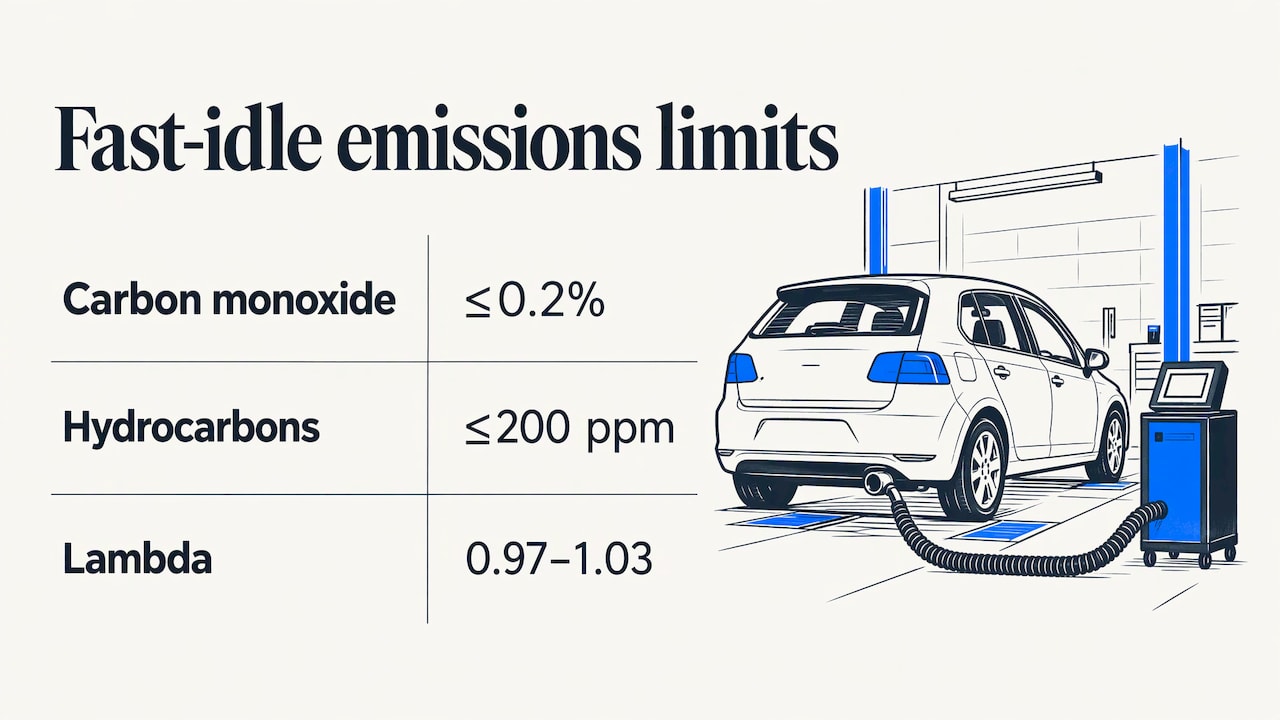
MOT testers check that emissions-control components such as converters and oxygen sensors are present where they should be, as the GOV.UK MOT inspection manual updates page (updated 14 October 2026) describes. Petrol cars first used on or after 1 August 1995 also get a catalyst emissions test. The DVSA’s exhaust emission standards booklet sets fast-idle limits of carbon monoxide at 0.2% or below, hydrocarbons at 200 ppm or below, and lambda between 0.97 and 1.03. A converter that is not working, or a misfire pushing hydrocarbons up, is a common way to fail.
How to fix catalytic converter problems
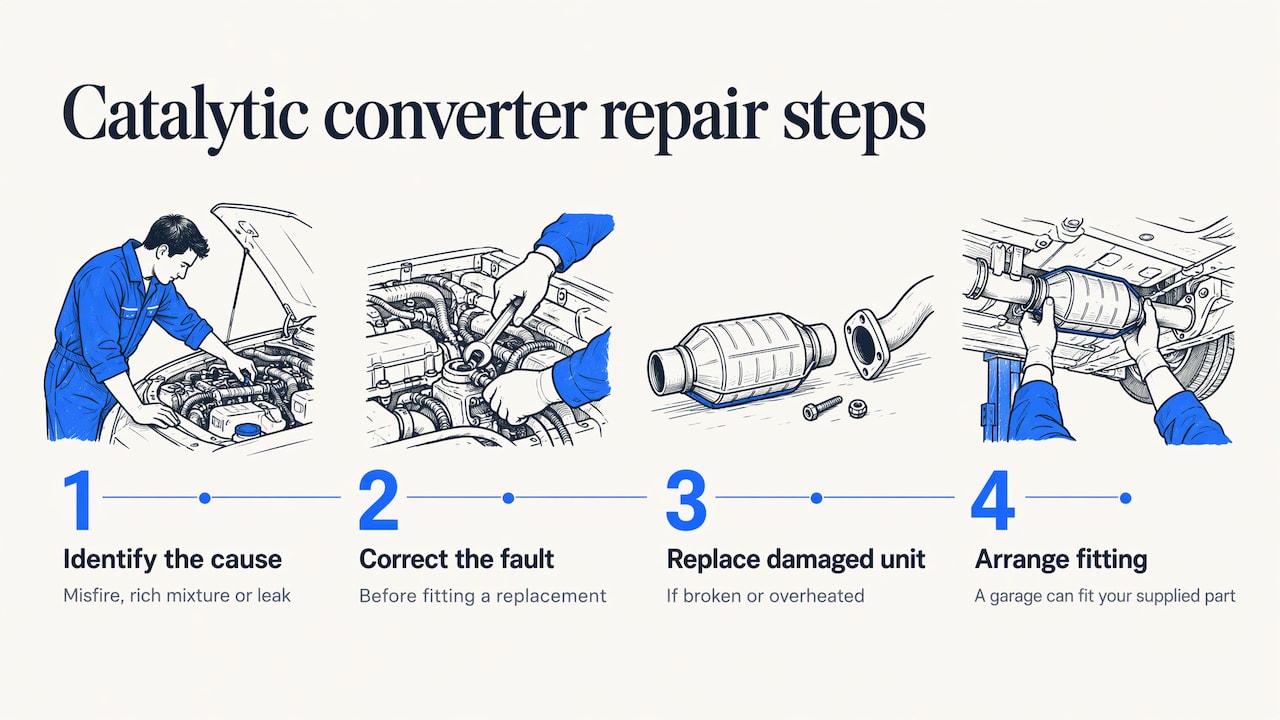
Start from the cause, not the converter. If a misfire, rich mixture or leak destroyed the old unit, a new one fitted over the same fault is at risk of the same fate. Correct the root cause, then replace what is damaged.
When the converter has been physically broken or its core has been overheated, the practical repair is a replacement unit. Do not remove the converter and leave it off. The Department for Transport’s in-use emissions consultation states that removing a three-way catalytic converter, often alongside sensor removal or ECU changes, is a modification it would always consider illegal. That is a consultation position, but it shows where the rules are heading, and a car without a converter will not pass its emissions test in any case.
If you do not do exhaust work yourself, a garage can fit the part. Buying the correct unit yourself and handing it over is a sensible way to control cost and quality.
Choosing the right replacement converter
This is the step where most money is lost, and it is simple to get right if you check three things.
1. Approval for your car
GOV.UK says a replacement converter for a vehicle registered on or after 1 March 2001 must be type-approved. For an earlier vehicle, a replacement need not be type-approved but should give equivalent performance to the original.
2. The markings on the unit
The same GOV.UK page says to look for permanent markings: the EC type-approval mark, the manufacturer’s name or trademark, the make and the identifying part number. If any of these is missing from a unit that needs approval, it is not the right part.
3. Fit to your exact vehicle
Same model name does not mean same converter. Engine variant, model year and emissions standard all change which unit fits. Matching by registration or VIN removes the guesswork, and our guide on finding the right part number shows how part numbers and cross references work if you are comparing against the old unit.
If the converter has failed, the sensors and other exhaust and electrical parts around it deserve a look at the same time, so you are not back under the car in a month.
Order the right part first time
At A-Z Motor Factors you can look up parts with your vehicle’s registration or VIN, which is designed to help you avoid the incorrect-match problem before you pay. Our exhaust and electrical range covers the parts around the converter, and the full car parts catalogue includes clutch, engine and cooling, service and filters, and more. UK delivery is free on orders over £25, delivery is listed at £7.00, and there is a 30-day return policy. We supply retail customers, garages and trade clients.

Garages and trade buyers ordering several parts for one job can build the whole order against the same vehicle lookup.
Our view on converter problems
We think converter jobs go wrong in two places: before the part is chosen and after it is fitted.
Before: a warning light gets read as “replace the converter”, when the real cause is a misfire, a leak or a service item that was overdue. Diagnose first, and the converter stops being the expensive guess.
After: the new unit goes on over the same fault, or it turns out not to be the right one for that engine and that registration date.
That is why we built our service around checking the part against your registration or VIN before you buy. For a DIY motorist it takes away the uncertainty of matching. For a garage it protects the bay time. For trade customers it keeps repeat orders consistent.
Free UK delivery on orders over £25 and a 30-day return policy are there to take the sting out of a bad day under the car, but the best return is the one you never need to make.
FAQ
What are the first signs of a failing catalytic converter?
RAC Drive lists sluggish performance, reduced acceleration, dark exhaust smoke, a sulphur smell and excessive heat under the car. A rattle from underneath or a dashboard warning light can also appear. Get the fault codes read before deciding the converter is to blame.
Does a warning light always mean the converter is faulty?
No. Misfires, sensor faults and exhaust leaks can switch the light on too. A code reader and sensor readings tell you whether the converter is the cause, and a four-gas analyser gives the clearest picture.
Do I need a type-approved replacement?
If your car was registered on or after 1 March 2001, yes, according to GOV.UK. Check the unit carries the EC approval mark, manufacturer name or trademark, make and part number. For older cars, the replacement should give equivalent performance to the original.
Is it legal to remove the converter?
No, it should not be removed. The Department for Transport’s consultation says it would always consider removing a three-way converter illegal. A car without one is also likely to fail the emissions part of its MOT.
Sources
- What is a catalytic converter? | RAC Drive
- What is a catalytic converter? | AXA UK
- What is a catalytic converter? | Carwow
- AECC: Catalysts, from oxidation catalysts to three-way
- Diagnosing a catalytic converter fault | Professional Motor Mechanic
- Catalytic converters and diesel particulate filters | GOV.UK
- MOT inspection manual updates | GOV.UK
- In service exhaust emission standards for road vehicles | DVSA
- Regulating environmental impact of in-use emissions of road vehicles | GOV.UK